
Haigazian University
Baccalaureate Service 2026
First Armenian Evangelical Church, Sunday, 31 May 2026
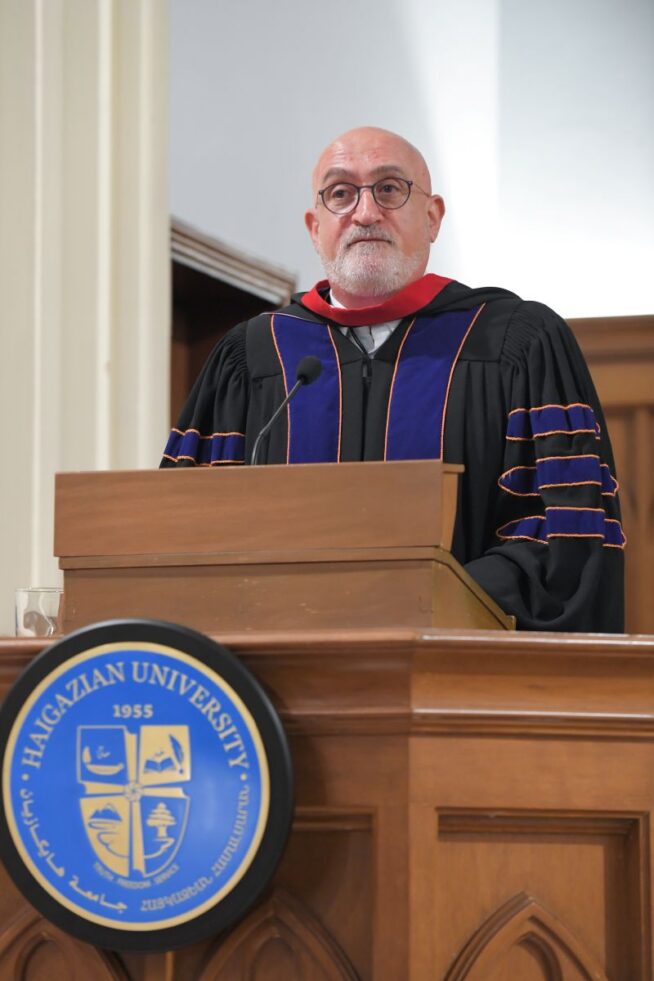
Dr Nicolas Abou Mrad
“Peace I Leave With You”
(John 14:27)
Dear members of the graduating class,
Distinguished President Rev. Dr. Paul Haidostian,
Members of the Board of Trustees,
Distinguished faculty,
Families and friends,
Members of the Haigazian University community,
Allow me first to say how honored I am to have been invited to address you this evening, at this meaningful Baccalaureate Service preceding next week’s commencement. I wish to express my sincere gratitude to President Rev. Dr. Paul Haidostian, with appreciation for his friendship and leadership, as well as to the members of the Board of Trustees and the entire Haigazian community for this generous invitation.
I stand before you this evening with deep appreciation for the spirit of openness, intellectual seriousness, and human concern that has long characterized Haigazian University and its Armenian Evangelical heritage within Lebanese academic and cultural life.
A university is one of the rare places where human beings are invited to read carefully, think critically, and resist the temptation of simplistic answers. That discipline becomes especially important in an age shaped by social media reactions, misinformation, and the constant confusion between noise and knowledge. One of the responsibilities of education is therefore discernment: the ability to distinguish between information and wisdom, and between emotional reaction and thoughtful judgment.
The theme chosen for this evening comes from the Gospel of John: “Peace I leave with you; my peace I give to you. I do not give to you as the world gives.” These words were spoken by Christ to His disciples during a moment of uncertainty and anxiety. They were spoken not in comfort, but in the midst of fear and instability Perhaps that is why they continue to resonate so deeply today — especially here in Lebanon and throughout the Middle East.
You are preparing to graduate in a region that has endured many hardships. Your generation has witnessed economic crises, displacement, instability, and profound social challenges. Yet you have also witnessed resilience, solidarity, generosity, and the remarkable persistence with which people continue to rebuild their lives and communities. And despite every difficulty, you are gathered here tonight on the threshold of graduation, as women and men who chose perseverance, discipline, and hope. That perseverance deserves recognition.
The peace Christ speaks about is not superficial peace. It is not indifference, passivity, or avoidance. It is something deeper: a way of inhabiting the world without surrendering to fear or hostility. True peace does not erase differences. It teaches us how to live with them constructively and humanely. And perhaps it is meaningful that this Baccalaureate Service takes place on the eve of Pentecost according to the Eastern Christian calendar. In the biblical account of Pentecost, the disciples receive the Holy Spirit and begin to speak in ways that allow people from many nations and languages gathered in Jerusalem to understand what was being proclaimed. Difference is not abolished. Yet understanding becomes possible. Perhaps this too is a profound image of peace: not the disappearance of human diversity, but the discovery that truth, dignity, and compassion can still be shared across our differences.
In Lebanon, we often speak about coexistence. But genuine coexistence requires more than proximity. It requires intellectual honesty, humility, and the willingness to recognize the dignity of another person even when we disagree.
As someone whose academic work has focused on biblical studies and the Old Testament, I have become deeply aware that sacred texts can either illuminate human conscience or be manipulated in ways that obscure it. Throughout history — including in our own region today — religious language and biblical texts have sometimes been used selectively to justify exclusion, domination, and violence. Yet when scripture is used to deny the humanity of another person, something essential has already been lost.
The Bible, in both the Old and New Testaments, does not ignore the realities of conflict, suffering, injustice, or human failure. It speaks honestly about the complexities of human history. But the deeper movement of the biblical story is not toward death. It is toward life. From the opening chapters of Genesis, the Bible presents creation as fundamentally good.
Human beings are created in the image of God, entrusted with responsibility, freedom, and care for the world around them. This affirmation carries profound ethical consequences. If every human being bears the divine image, then no life can be treated as disposable, no community as insignificant, and no act of violence as spiritually trivial. To honor the image of God in humanity is to choose responsibility over destruction, order over chaos, and reverence for life over the normalization of violence.
Peace, in this sense, is not simply a political aspiration. It is participation in God’s intention for creation itself. Again and again, the biblical witness calls humanity toward justice, mercy, reconciliation, and peace. The prophets envision a world in which swords become plowshares. The Psalms unite righteousness and peace. Christ calls peacemakers blessed. And the Gospel continually reminds us that love of God cannot be separated from love of neighbor.
This vision is neither naive nor passive. Peace is sustained not by passivity, but by moral courage and disciplined restraint. Faith should never become a justification for hatred or contempt. It should deepen our capacity for compassion, responsibility, and reverence for life.
As members of a graduating class, many of you will become educators, physicians, entrepreneurs, artists, engineers, researchers, public servants, and community leaders. Some of you may remain in Lebanon. Others may continue your journeys elsewhere in the world. But wherever life takes you, I hope you will carry with you not only knowledge, but wisdom; not only ambition, but integrity; not only professional competence, but also moral responsibility. Our societies do not simply need skilled individuals. They need trustworthy individuals. They need people capable of building institutions, restoring confidence, strengthening communities, and cultivating hope.
One of the greatest dangers of our age is cynicism—the belief that nothing meaningful can change, that ideals are illusions, and that self-interest is the only realistic principle by which to live. Do not surrender to that cynicism. The fact that human beings are capable of cruelty does not negate their capacity for goodness, creativity, solidarity, and renewal.
Tonight, as you stand before commencement, you carry more than future careers or academic accomplishments waiting to be formally recognized You carry the responsibility to defend truth with integrity, to use freedom responsibly, and to place your knowledge and talents at the service of others. You carry the responsibility to strengthen trust where there is suspicion, to encourage dialogue where there is division, and to uphold the dignity and worth of every human being.
And perhaps this is one of the deepest meanings of the peace spoken of in the Gospel: a peace rooted not in denial, but in courage; a peace capable of sustaining hope even in difficult times; a peace that invites human beings to remain open to one another and to the future.
Dear members of the graduating class, this evening is not simply a ceremony before commencement. It is also an affirmation. An affirmation that truth matters. That freedom carries responsibility. That service gives meaning to education. And that human dignity must always remain at the center of public life.
May the knowledge you have acquired here become a source of wisdom, may your freedom become a source of responsibility, and may your success become a source of service to others. And may you help build societies in which truth is honored, human dignity is protected, and peace is pursued not only in words, but in daily life. May you go forward with wisdom, integrity, and generosity of spirit. And may the peace spoken of in the Gospel become not only an ideal you admire, but a responsibility you choose to embody. Thank you.