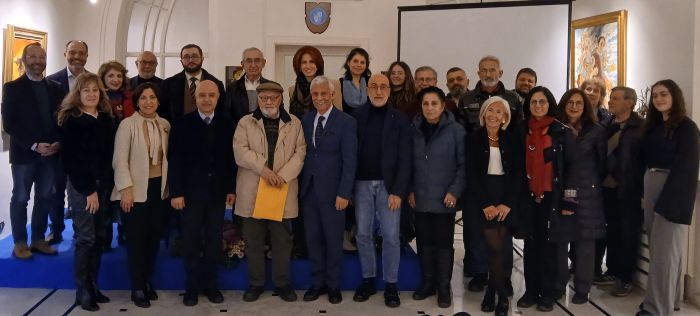
PROHLA, a volunteer group under the Haigazian University-based Armenian Diaspora Research Center (ADRC), launched its first public event series, called “My Story”, on Thursday, February 26, at the Mugar Hall of Haigazian University.
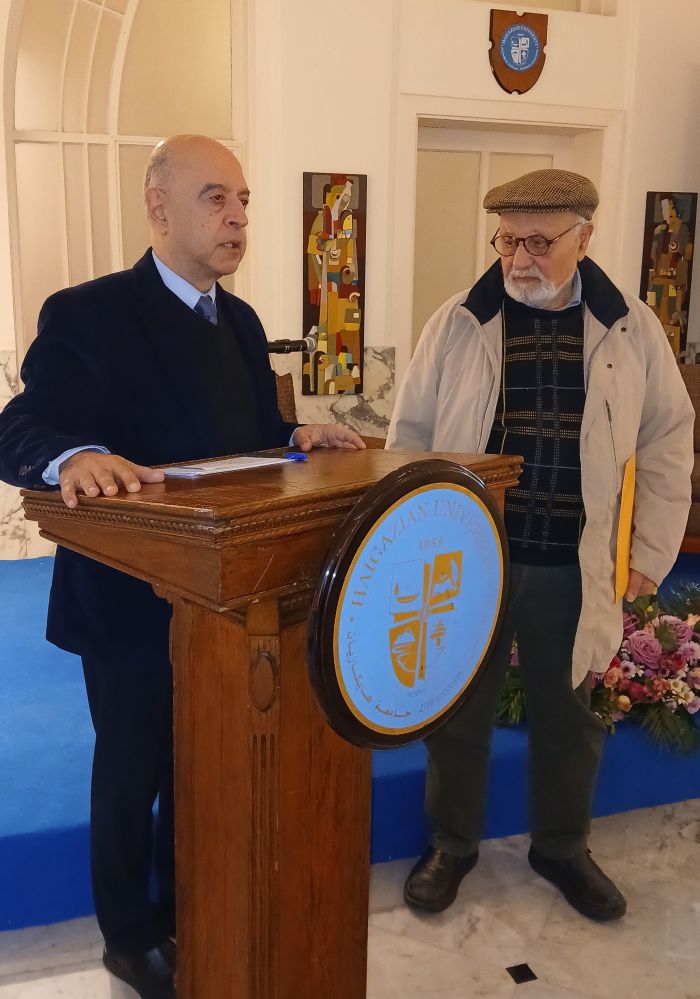
In his welcoming word, PROHLA member, conductor Krikor Allozian, described the mission of the group as preservation of Lebanese Armenian Culture and the dissemination of awareness in identity issues. Allozian noted that the “My Story” series was about memory, identity and the life route of the individual story teller. He explained that this was a way of preserving culture through sharing individual experiences and connecting them to forming a bridge between them and others. He noted that every life is a value in itself and by telling the story of his life, the individual re-lives it and passes it on to others. Allozian called on each individual to be inspired by the event and look at their lives and place in the broader context of the community and society. He then invited the guest of the day, the renowned Lebanese Armenian painter Mr. Krikor Norigian, and PROHLA member Dr. Antranik Dakessian to take a seat on the podium.
Dr. Dakessian briefly presented artist Norigian as the Mohican of the painters of his generation living in Beirut, and added that Norigian had become a renowned painter as of the mid-1960s, thanks to his collective and individual exhibitions in Beirut, Europe, the USA and Canada, his talent and unique art. Dr. Dakessian raised different questions and asked Norigian to recount to the audience episodes of his early childhood and produce a composition of life stories.
Norigian, thanked the audience and presented his life story by narrating episodes of his early childhood in the late 1940s and early 1950s at the Trad residential quarter, a section of the now renowned Armenian Bourj Hammoud.
Norigian’s anecdotes painted the picture of a community that had a simple life, was trying to rebuild whatever was destroyed by the uprooting and exile. He presented the inhabitants of the quarter as unassuming, modest individuals making every effort to earn a living, send their children to schools and improve their social conditions after what they had faced during the Armenian Genocide.
Norigian spoke about his teenage years in Ashrafieh, his education and his work at the printing house of his maternal uncle in Azarieh at the same time as his studies in drawing and painting. The renowned artist reminisced about episodes from his artistic life in Paris, which was meant to be a short trip but lasted for almost 3 decades until 2003, when he returned to Beirut for good. His anecdotes included some of his exhibitions, his encounter with the world-famous photographer Yususf Karsh, who came to his exhibition in Canada, congratulated him and advised him to keep on going without hesitation and paying no attention to whatever he was being told….
Norigian’s story-telling went on for more than an hour. It was accompanied by a number of old family photos which stretched from the early 20s to the 70s of the twentieth century.
One of the main questions the artist repeatedly raised was, “What do we want from life, both as an individual and as a nation?”
Norigian’s life story was more than a flashback for him and the audience, a sort of a retrospective of the artist’s life, which shed light on some deep aspects of his life, thoughts, mindset, the societies and conditions he lived in.
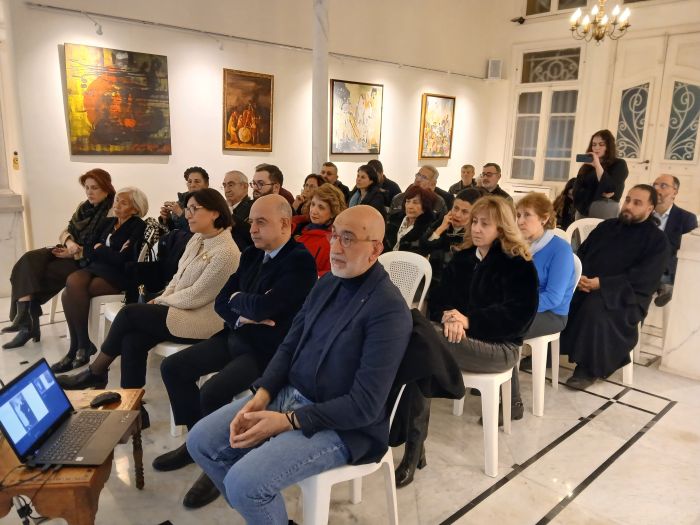
The audience listened to his tale attentively and asked some questions about his art and messages, his perception of art.
In closing, HU President Rev. Dr. Paul Haidostian thanked the organizers, highly appreciated the treasured and longstanding contribution of Krikor Norigian in the fields of visual art and gave a short conclusion highlighting two main points: pride in what was achieved and humility in the face of challenges.